91.2% of LDM students pass the LTO exam first time. With 15 years experience and 46K students trained, we know exactly what it takes to get you licensed — faster, with less stress.
A simple path for first-time drivers: learn the basics, get support if you need it, practise properly, then take the LTO exam with confidence.
All taught by LTO-certified LDM instructors. Priced 10% below market — without compromising quality.

The mandatory 15-hour theory class to get your Student Permit. Covers traffic signs, road rules, speed limits and more.

The mandatory 8-hour behind-the-wheel course to get your Non-Professional Driver's License. Auto or manual.

One-on-one lessons tailored to your pace and weak areas. Online or in-person. The fastest way to pass.

Premium one-on-one for private individuals and corporate clients. Our certified instructor comes to you.

Confident in the city but nervous on the highway? Build skills for SLEX, NLEX and SKYWAY.

Been a while since you drove? Our refresher gets you back on the road safely and confidently.

Simulate the real LTO practical exam — real conditions, routes and scoring criteria used by LTO examiners.

Customised driving programmes for companies and organisations. We handle scheduling, venue and instructors.
Bundle your theory and practical training so the full licensing process is easier to plan, easier to budget, and easier to finish.

Automatic-friendly starter package for students who want a simpler first driving experience.

For learners who want more confidence handling larger vehicles with certified guidance.

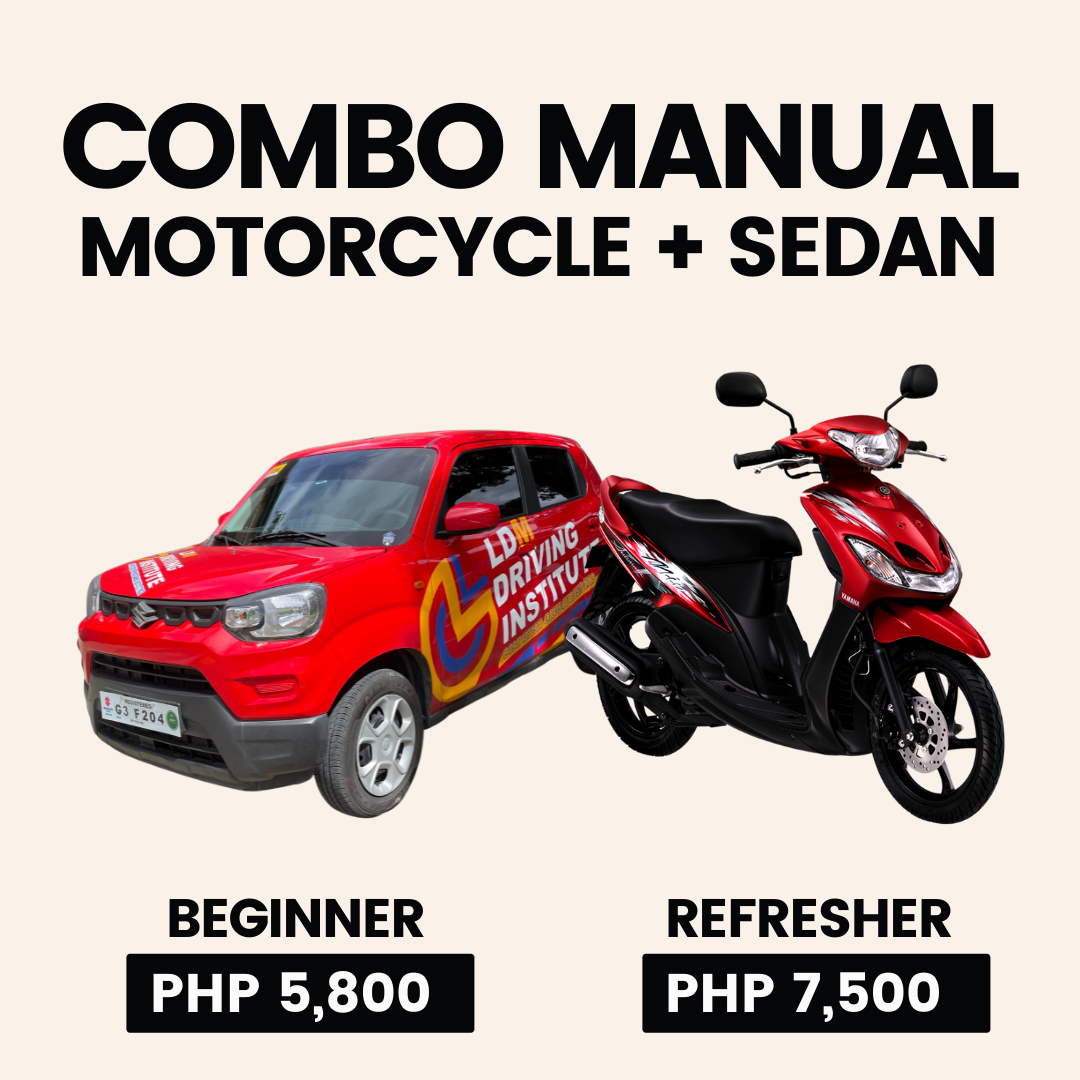
Best for students who want stronger clutch control, road discipline, and manual confidence.
LDM instructors focus on calm coaching, road safety, and the exact skills students need for the LTO exam and everyday driving. Choose group lessons, private tutoring, or executive service depending on how much support you need.
Clear explanations for road signs, rules, right of way, violations, and real LTO question patterns.
Patient behind-the-wheel coaching for beginners, refreshers, manual, automatic, and road confidence.
Personalized online or face-to-face help for students who want the fastest improvement.
Premium instructor support for private clients and corporate groups, with flexible arrangements.
Three locations across Quezon City — all LTO accredited, with certified instructors and flexible schedules.
Everything you need to pass the LTO theory exam is right here — for free. These topics are taken directly from the official LTO reviewer and Comprehensive Driver's Education materials. Study each section, then test yourself with our theory practice exam.
Official LTO Filipino Driver's Manual PDFOnce you've studied the topics below, take our 60-question theory practice exam under real exam conditions.
Shape: Circular or octagonal. These are laws you must obey — ignoring them is an offense.
Stop sign: Octagonal, red. Come to a complete stop before the line and proceed only when safe.
Yield sign: Triangular, red border. Slow down and give way to traffic on the main road.
Do Not Enter: Round, red circle with white bar. No entry under any circumstance.
Shape: Yellow triangular. Warns of hazards or changes in road conditions ahead.
Examples: sharp curves, intersections, school zones, railway crossings, slippery roads.
Color: Blue background. Provides helpful information — hospitals, fuel, direction, distance.
Green signs: Used on expressways for directions and destinations.
Red: Stop completely before the stop line. Do not proceed.
Yellow/Amber: Prepare to stop. Do not speed up to beat the light.
Green: Go — but yield to pedestrians and vehicles still clearing the intersection.
Flashing red: Treat as a stop sign — come to a complete stop, then proceed when safe.
Flashing yellow: Slow down and proceed with caution — no need to stop completely.
Green arrow = you may go in that direction only. Red arrow = you must not go in that direction even if the main light is green.
Solid double yellow: No overtaking in either direction under any circumstances.
Broken yellow on your side: You may cross to overtake if safe. Solid on your side = no crossing.
Solid white: Separates same-direction lanes. Do not cross except in emergencies.
Broken white: You may change lanes when safe to do so.
Stop line: Solid white line across the road — stop before this line at signals and stop signs.
Pedestrian crossing (zebra): Give way to all pedestrians on or approaching the crossing.
Arrows on pavement: You must follow the direction shown — no choice once in that lane.
Left turn: Extend left arm straight out horizontally from the window.
Right turn: Extend left arm out and bend it upward at the elbow (hand pointing up).
Slow down / Stop: Extend left arm out and bend it downward at the elbow (hand pointing toward ground).
Hand signals are given with the left arm — never the right. Signal at least 30 meters before you turn or stop.
Vehicle already in the intersection has right of way over approaching vehicles.
Two vehicles arriving at the same time: yield to the vehicle on your right.
Turning left: always yield to oncoming traffic going straight.
Vehicles already inside the rotunda have the right of way. Vehicles entering must yield.
Always give way to pedestrians at crossings. At school crossings, stop and do not move until ALL persons have completely cleared the crossing.
When you hear a siren on a two-way street, pull to the right and stop to allow the emergency vehicle to pass.
When two vehicles meet on a narrow upgrade and cannot pass, the vehicle facing downhill must yield and reverse.
Only when the road ahead is clearly visible and free of oncoming traffic for a sufficient distance.
You may pass to the right only on roads with two or more lanes moving in the same direction.
After overtaking, return to your lane only when you can see the passed vehicle in your rear-view mirror.
On curves, hills, or crests where you cannot see far ahead.
At or approaching bridges, tunnels, or railway crossings.
At intersections or pedestrian crossings.
Where there are solid yellow or white lines on your side of the road.
Never use the road shoulder to overtake — this is against the law.
Expressway: Maximum 100 kph
School zones (school days): Maximum 20 kph
Residential/business areas: As posted — usually 30–60 kph
You must never drive faster than what is safe for current conditions — regardless of the posted limit.
Speed limit signs show the maximum under ideal conditions. In rain, fog, or heavy traffic — drive slower.
Never drive faster than the distance your headlights illuminate. If you can only see 50 meters ahead, you must be able to stop within 50 meters.
Downhill with a curb: Turn front wheels INTO the curb (toward the road edge).
Uphill with a curb: Turn front wheels AWAY from the curb (toward the road center).
Uphill without a curb: Turn wheels sharply to the RIGHT so the car rolls away from traffic if it moves.
On a pedestrian crossing or crosswalk.
Within 6 meters of a fire hydrant.
On a bridge, tunnel, or railway crossing.
In front of a driveway or entrance blocking access.
Always stop the engine, engage the handbrake, and secure the vehicle before leaving it unattended.
Student permit: Required before applying for a license. Valid for 1 year.
Non-professional license: For private vehicles only.
Professional license: Required to drive public utility vehicles (PUVs).
A driver's license is a privilege, not a right. It can be suspended or revoked.
Suspended: License taken away temporarily by the LTO.
Revoked: License taken away permanently by the LTO.
If your license is apprehended, you must settle your case with the LTO within 15 days to avoid suspension or revocation.
You may never lend your driver's license to another person under any circumstances.
60 randomly selected LTO questions under real exam conditions. Pay P150 via GCash and get your full results, score breakdown and personalised study tips.
Please fill in all fields correctly.
P150 via GCash · Full results + weak areas + study tips emailed within 30 minutes · Trusted by 46K students
Please enter a valid GCash reference number (min 6 digits).
Please enter your 6-character access code.
"I was so nervous about the LTO exam but the theory practice exam helped me practice so much. I passed on my first attempt with 52 out of 60. Thank you LDM!"
"The study tips after the exam were really helpful. I found out I was weak on road markings so I focused on that. Passed the real exam a week later."
"I took the theory practice exam 4 times — different questions each time. By the time I sat the real LTO exam I was completely confident. Worth every peso."